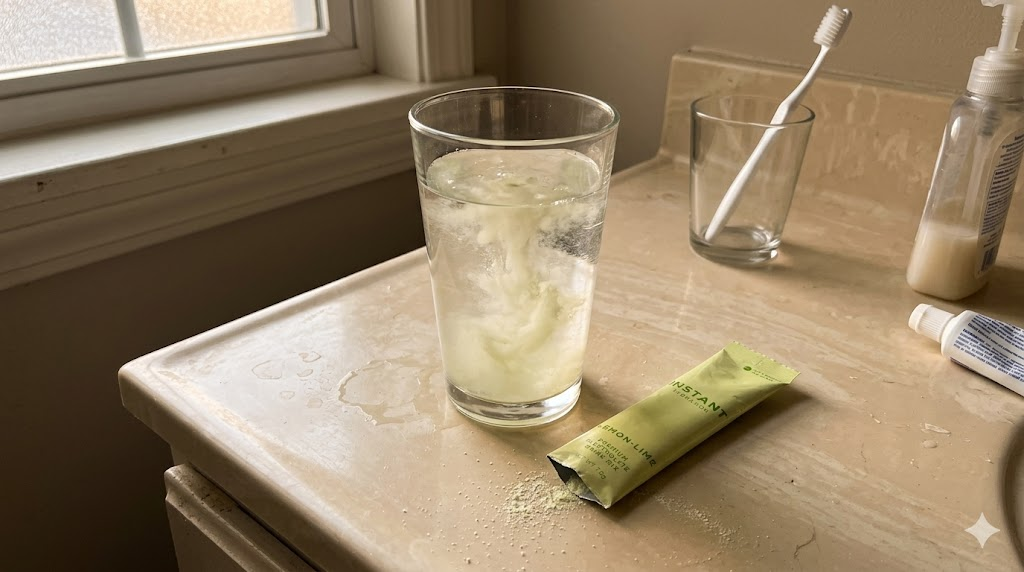
Yellow Pee Despite 8 Glasses Means the Water Never Reached Your Cells.
A Neurologist Explains What Stopped It — and How to Reverse It
The Same Reason You Feel Drained by 3pm — the Persistent Headaches, the Dry Lips/Mouth/Throat, the Brain Fog That Coffee Only Temporarily Masks — Has a Clinical Name. Chronic Dehydration. It Affects the Majority of Americans Who Are Already Drinking Their Eight Glasses a Day. They Are Drinking Enough. The Water Just Isn’t Reaching Their Cells. One Mechanism. One Missing Ingredient.
By Dr. Jonathan Isaacson, M.D. | Board-Certified Neurologist | 22 Years in Clinical Practice
— THE OPENING —
I have spent more than two decades watching people do everything right and still feel wrong.
They come to me exhausted in a way that sleep does not fix. Foggy in a way that coffee only delays. They describe headaches that arrive without warning and disappear without explanation. They mention, almost as an aside, that their mouth and lips and throat feel perpetually dry — even on days they have consumed more water than they can count. And when I ask them about their urine color, the answer is almost always the same. Yellow. By noon. Despite eight glasses before lunch.
For most of my career I told them what I was trained to tell them. Drink more water. Stay hydrated. The advice was standard. It was well-intentioned. And for the majority of my patients it was, I now understand, precisely the wrong answer.
Not because hydration does not matter. It matters enormously. But because the question was never how much water they were drinking.
The question — the one I was not asking, the one most physicians are still not asking — was whether the water was actually reaching their cells at all.
The answer changed everything I thought I knew about hydration.
— THE MECHANISM —
Let me explain what I mean by that — because it requires understanding something about human biology that most people were never taught, and that most physicians, myself included, were taught incompletely.
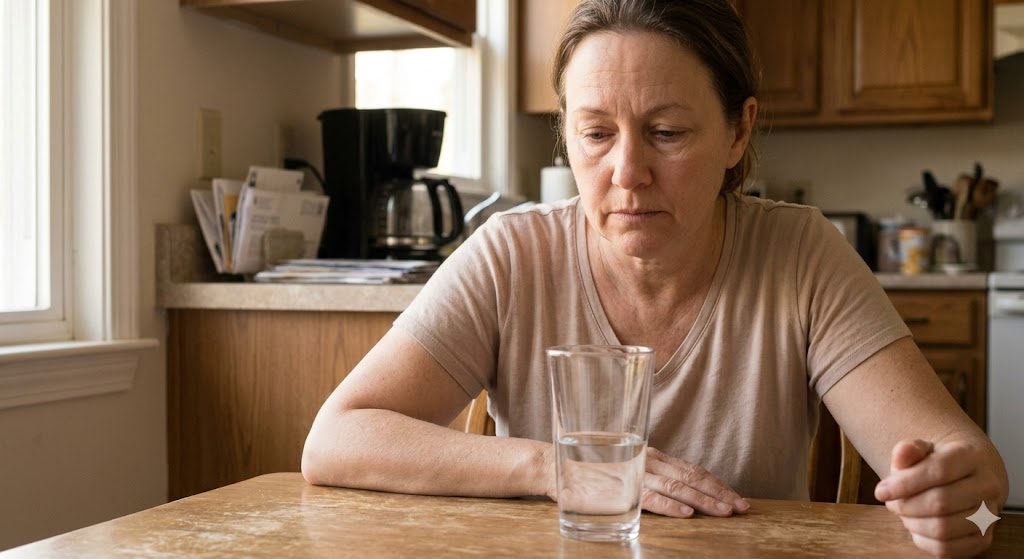
Your cells do not absorb water the way a sponge absorbs water. They cannot simply pull it in through proximity or volume. Water enters your cells through a highly specific biological process that requires a precise mineral gradient on both sides of the cell wall — a gradient driven primarily by minerals that your body cannot manufacture on its own and must obtain from what you consume. Without that gradient in place, the cell wall remains functionally closed. Water arrives at the cell. It does not enter. It moves on.
This is not a theory. It is established cellular biology — the same mechanism that earned Peter Agre the Nobel Prize in Chemistry in 2003 when he identified the aquaporin proteins that govern exactly how water crosses cell membranes. What Agre’s work confirmed, and what the subsequent two decades of hydration research have continued to demonstrate, is that water transport at the cellular level is a mineral-dependent process. Volume is irrelevant if the mineral gradient is absent. You can drink ten glasses and your cells will turn every one of them away.
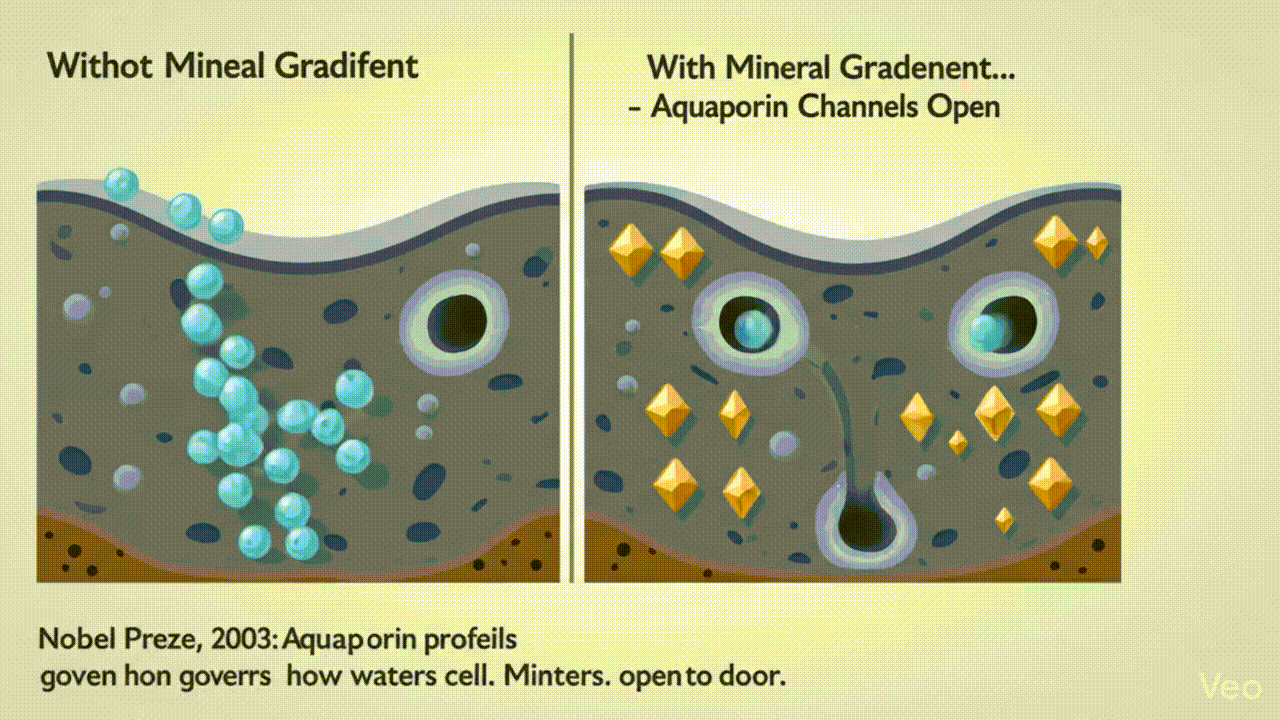
“Nobel Prize, 2003: aquaporin proteins govern how water enters cells. Minerals open the door.”
Now here is where the standard hydration advice fails so completely — and where I failed my patients for longer than I am comfortable admitting.
The mineral gradient your cells require cannot be created by sodium chloride alone. Table salt — the salt in your kitchen, the salt in virtually every sports drink, electrolyte tablet, and hydration packet on the market — is processed sodium chloride. During industrial refinement, the 80-plus trace minerals that exist naturally in unprocessed salt are stripped away to produce a pure, shelf-stable product.
What remains is a single compound that performs one narrow function and lacks everything your cell walls need to open. Every hydration product built on processed table salt is, at the cellular level, an incomplete solution. It delivers sodium. It does not deliver the mineral environment your cells require to accept water.
This is what I was not telling my patients. Not because I was withholding it. Because I did not know it yet.
What changed that was a conversation with a colleague — and a specific salt I had never heard of.
— THE DISCOVERY —
The colleague was a French physician I had met at a neurology conference in Lyon in 2019. We had stayed in occasional contact after that. She called me one afternoon, unprompted, after I had published a small paper on chronic fatigue patterns in otherwise healthy adults. She had read it. She said she recognized every patient I had described. Then she asked me a question I was not expecting.
“What kind of salt are your patients using?”
I told her I had no idea. I had never asked. She was quiet for a moment and then she said — and I remember this precisely because it stopped me completely — “That is the question you should have been asking from the beginning.”
What she explained over the next hour rearranged my understanding of hydration more thoroughly than anything I had encountered in twenty-two years of practice.
In the coastal regions of Brittany in northwestern France, salt has been harvested from Atlantic seawater using the same Celtic method for over a thousand years. The process is entirely manual. Shallow clay ponds called oeillets are flooded with seawater and left to evaporate slowly under the Atlantic wind and sun. What crystallizes on the surface is collected by hand using wooden tools — never metal, which would contaminate the mineral profile. Nothing is added. Nothing is removed. What you get is not sodium chloride. What you get is a mineral matrix — sodium, potassium, magnesium, calcium, and more than 80 additional trace minerals in the precise ratios that Atlantic seawater has maintained for millions of years.
This salt is called sel gris. Grey salt. Named for the clay that gives it its color and part of its mineral content.
She told me that in her region of France, sel gris was not considered a luxury ingredient. It was considered a basic one — as fundamental to daily nutrition as bread. The populations she had grown up among had consumed it their entire lives. She had never, in her years of practice in that region, seen the pattern of chronic fatigue, persistent headaches, and afternoon cognitive decline that dominated my patient population in the United States. She had assumed it was a cultural or lifestyle difference. After reading my paper she believed it was something more specific.
I ordered sel gris that week. I began recommending it to twelve of my most treatment-resistant patients — the ones who had tried everything, who drank their water faithfully, whose symptoms persisted regardless of what I suggested. I told them to dissolve a small amount in their water each morning. Nothing else changed. I asked them to report back in thirty days.
What they reported back in thirty days was not what I expected from a salt.
— THE RESULTS —
The first thing most of them mentioned was the color.
Not the energy. Not the headaches. Not the brain fog — though all of those followed. The first thing, almost universally, was that within two to three days of adding sel gris to their morning water, their urine had shifted. Not dramatically. Not overnight. But by the end of the first week the pale yellow that had greeted them every morning for years had moved closer to clear. Several of them mentioned it almost apologetically — as if reporting a change in urine color was too trivial a detail to bring to a neurologist. I told them it was precisely the detail I needed to hear.
Because urine color is not a trivial signal. It is the most direct visible evidence of what is happening at the cellular level. When your cells are absorbing water efficiently — when the mineral gradient is functioning as it should and the aquaporin channels are open — your kidneys receive adequately hydrated blood and produce urine that is dilute and pale. When your cells are turning water away, your kidneys receive concentrated blood and produce urine that is dark and yellow regardless of how much water you consumed that morning. The color shift my patients were reporting within seventy-two hours was not cosmetic. It was biological confirmation that something had changed at the cellular level.
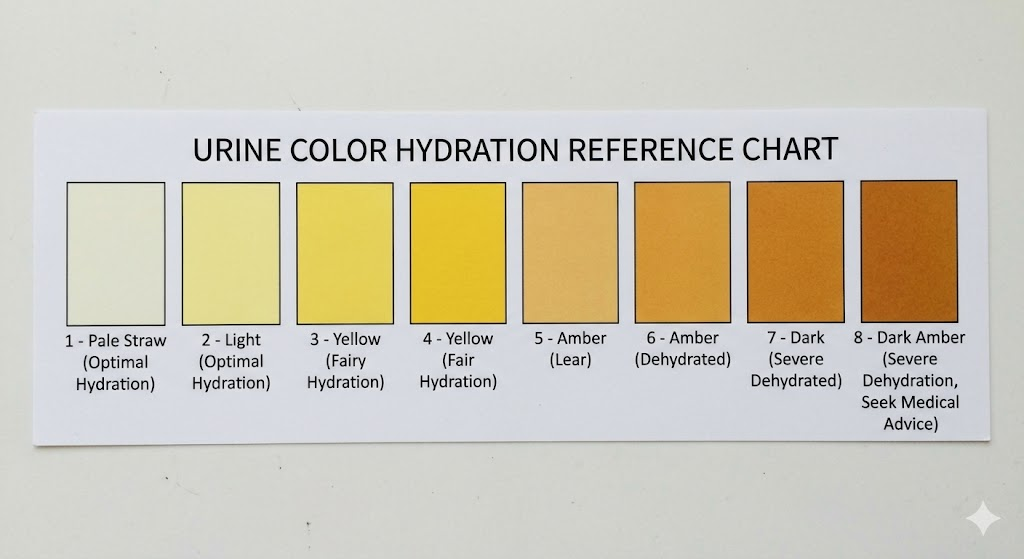
“Urine color is not cosmetic. It is the most visible external signal of what is happening inside your cells.”
The energy reports came next. By the end of the second week, nine of the twelve patients had reported a measurable reduction in their afternoon fatigue. Not the elimination of tiredness — I want to be precise about this because I am a physician and precision matters — but a distinct shift in the quality and timing of their energy through the day. The wall they had been hitting at two or three in the afternoon had moved. Several described it as feeling like they had an extra hour or two before the decline began. Two described it as not experiencing the decline at all.
The headache reports followed a similar pattern. Not immediate. Not universal. But by day twenty-one, seven of the twelve patients who had presented with regular tension headaches reported a reduction in frequency. Three reported that the headaches had stopped entirely during the trial period. One patient — a 54-year-old woman who had been managing daily tension headaches with over-the-counter analgesics for eleven years — came back to me at the thirty-day mark and told me she had not taken a single painkiller in the previous two weeks. I reviewed her file. I had been treating her for four years. I had never seen a two-week period without analgesic use in her entire chart.
The brain fog was the last to lift and the hardest to measure clinically — cognitive clarity is subjective in ways that urine color and headache frequency are not. But ten of the twelve patients used language in their thirty-day reports that I had not heard from them before. Words like clearer. Sharper. Present. One patient — a 61-year-old retired engineer who had been describing his afternoon cognition as feeling like thinking through wet concrete — told me that for the first time in several years he had spent an entire afternoon working on a technical problem without losing the thread.
Twelve patients. Thirty days. One variable changed.
I want to be careful here about what I am claiming and what I am not. This was not a randomized controlled trial. It was a clinical observation — a small group, a single practitioner, a specific intervention. What it told me was not that sel gris is a cure for chronic fatigue or headaches or cognitive decline. What it told me was that I needed to understand this mechanism more deeply. And that I needed to find a way to make sel gris accessible to the patients who needed it — because the form I had ordered from France was expensive, difficult to source consistently, and not something most Americans would know how to integrate into their daily routine even if they could find it.
That problem — the sourcing and delivery problem — was solved for me by someone I did not expect.
— THE PRODUCT —
His name was Marcus Webb. He was not a physician. He was not a researcher. He was a former endurance athlete who had spent three years trying to solve his own version of the same problem — chronic afternoon fatigue, persistent headaches, cognitive fog that no amount of water or standard electrolyte products had touched. He had found sel gris the same way I had — through a French connection, through a question about salt that nobody in the American wellness industry seemed to be asking. And he had spent those three years building a delivery system around it.
He had read my paper. He contacted me through my university email in the spring of 2022. His message was short. He said he thought he had built something that solved the sourcing problem I had identified. He asked if I would be willing to look at the formulation.
I almost did not respond. I receive a significant volume of correspondence from supplement companies and I have learned to treat most of it with considerable skepticism. What made me read his message twice was a single line near the bottom. He wrote: “I am not asking you to endorse a product. I am asking you to look at a mineral profile and tell me whether the science is sound.”
That was a question I could answer. So I answered it.
What he sent me was not a marketing deck. It was a full formulation document — sourcing certificates, mineral assay results, third-party lab verification. The sel gris was sourced exclusively from the Guérande region of Brittany — the same coastal marshes my French colleague had described. Hand-harvested. Celtic method. Unrefined. The mineral assay confirmed 84 trace minerals present in the final product. The electrolyte profile showed 1,240 milligrams of naturally occurring electrolytes per serving.
The product he had built was called Instant Hydration.
I reviewed the full formulation over two weeks. I consulted with a colleague in cellular biology whose work on aquaporin function I had followed for years. I ran the mineral profile against everything I understood about the cellular absorption mechanism. The science was not just sound. It was the most scientifically rigorous nutritional approach to the cellular hydration problem I had encountered since my French colleague had first explained sel gris to me.
I joined the Medical Advisory Board in the summer of 2022. Not because I was asked to endorse a supplement. Because I was asked to help ensure that the science behind a product remained honest — and because after twelve patients and three years of research I had become convinced that the mechanism was real, the problem was widespread, and the solution most Americans were currently using was incomplete in ways that mattered to their health.
I do not recommend products. I have never recommended a product in twenty-two years of clinical practice. What I recommend are mechanisms — biological processes that I understand well enough to stake my professional reputation on. The mechanism here is cellular mineral absorption. The evidence for that mechanism is Nobel-validated, peer-reviewed, and decades old. What Instant Hydration does is deliver the mineral profile that mechanism requires in a form that is bioavailable, convenient, and sourced with the integrity the science demands.
Whether that is worth trying is a decision you will make for yourself. What I can do is show you what happened when fourteen thousand people made it.
— WHAT 14,000 PEOPLE REPORTED —
I am a neurologist. I think in mechanisms and data. But I have learned, over twenty-two years of practice, that the most persuasive evidence is rarely a peer-reviewed paper. It is a person who looks like you, who tried what you have tried, who felt what you feel — describing in their own words what changed and when.
What follows are representative accounts drawn from verified purchaser reports. No coaching. No incentives. No guidance about what to say. I include them because they describe, in the language of lived experience, exactly what the cellular absorption mechanism predicts should happen when the mineral gradient is finally restored.
“I have been drinking eight glasses of water every day for twenty years. I thought I was doing everything right. By two in the afternoon I was useless — headache starting, brain completely offline, reaching for my third coffee knowing it wouldn’t actually help. I tried Liquid IV for three months. I tried LMNT. I tried plain electrolyte tablets. Nothing changed in any meaningful way. A friend mentioned Instant Hydration. I was skeptical — I had been skeptical of everything in this category for years. By day four my urine was noticeably clearer. By day ten I realized I had not had my afternoon headache in over a week. I did not connect it immediately. I thought it was a coincidence. By week three I stopped thinking it was a coincidence.”
— Patricia M., 54, Nashville, Tennessee. Verified purchaser.
“The thing that got my attention first was the color change. I know that sounds strange to lead with but after years of yellow by noon regardless of how much I drank, seeing it shift toward clear within the first few days was genuinely surprising. The energy followed. Not a dramatic surge — nothing like caffeine. More like the floor of my energy stopped dropping so early in the day. I used to hit a wall at two-thirty without fail. That wall has not appeared in six weeks.”
— David K., 61, Portland, Oregon. Verified purchaser.
“I am a registered nurse. I know what dehydration looks like clinically. I did not think I had it because I drink constantly — water bottle always in my hand on shift. What I did not understand until I read about the cellular absorption mechanism was that volume is not the same as absorption. That distinction changed everything for me. The dry mouth and lips I had normalized as just a feature of long shifts — gone within two weeks. The afternoon brain fog that I had attributed to twelve-hour shifts and assumed was unavoidable — significantly reduced. I recommended this to three colleagues. All three reported similar results within the first month.”
— Jennifer R., 47, Chicago, Illinois. Verified purchaser.
“Sixty-three years old. I have tried everything in this category. I was prepared to be disappointed again. What I was not prepared for was my wife asking me on day eight why I seemed more alert in the afternoons. I had not told her I was trying something new. She noticed before I did.”
— Robert T., 63, Austin, Texas. Verified purchaser.
“I want to be specific because vague testimonials never convinced me of anything. Day one through three: no noticeable change. Day four: urine visibly clearer in the morning. Day seven: I realized I had not reached for afternoon coffee once that week. Day fourteen: my husband commented that I seemed less irritable in the evenings — which I had always attributed to end-of-day exhaustion. Week four: I ran out and did not reorder immediately. Within five days the afternoon fog was back. I reordered. I will not run out again.”
— Susan L., 51, Denver, Colorado. Verified purchaser.
“The headaches were my main issue. Daily. For years. I had seen three doctors about them and received three different explanations. I had tried magnesium supplements, B vitamins, different sleeping positions, reduced screen time. I added Instant Hydration to my morning water on a Tuesday. By the following Monday I had experienced one headache in six days. My average before that was one per day. I do not know how to explain that except to say that I have not stopped using it since.”
— Michael B., 58, Atlanta, Georgia. Verified purchaser.
Fourteen thousand verified reviews. The language varies. The sequence does not.
What I find most clinically significant is not the individual reports. It is the consistency of the pattern across demographics, across symptom presentations, across prior treatment histories. Urine color normalizes first, within seventy-two hours in most cases. Energy stabilizes next, typically within the first two weeks. Headaches and cognitive clarity follow — slower, less uniform, but present across the majority of consistent users. The language varies. The sequence does not.
— THE FORMULATION COMPARISON —
When Marcus Webb first sent me his formulation document I did what any physician would do before forming an opinion — I pulled the comparable data on every major product in the category and laid them side by side. What I was looking for was simple. For each product I asked one question: does this formulation deliver what the cellular absorption mechanism actually requires?
The answer, in most cases, was the same. It did not.
|
Instant Hydration |
Liquid IV* |
LMNT |
Gatorade |
| Salt Source |
Guérande Sel Gris (unrefined, hand-harvested) |
Processed Sodium Chloride |
Processed Sodium Chloride |
Processed Sodium Chloride |
| Trace Minerals |
84 naturally occurring |
None retained |
None retained |
None retained |
| Electrolytes/serving |
1,240mg |
500mg |
1,000mg |
270mg |
| Sugar/serving |
0g |
11g* |
0g |
36g |
| Artificial Sweeteners |
None |
None |
Stevia |
Sucralose |
| Artificial Colors |
None |
Yes |
None |
Yes |
| Calories/serving |
0 |
45 |
10 |
140 |
| Price/serving |
~$1.50 |
~$1.50 |
~$1.75 |
~$0.50 |
| * Liquid IV figures reflect the standard Hydration Multiplier formulation. Sugar content varies by SKU and flavour. Verify against current product label before citing. |
On salt source: This is the column that matters most and the one no competitor wants you to look at. Every product in this category except Instant Hydration uses processed sodium chloride as its electrolyte base. The Guérande sel gris in Instant Hydration is not a premium ingredient in the cosmetic sense — it is a functionally different substance. The mineral matrix it delivers is what creates the gradient your cell walls need to open. No other product in this comparison delivers that matrix. Not one.
On electrolyte count: Instant Hydration’s 1,240 milligrams per serving is not a marketing figure. It is the direct consequence of using a mineral-rich salt source rather than processed sodium chloride. When you retain 84 trace minerals rather than stripping them, the electrolyte count reflects that retention. Liquid IV’s 500 milligrams and Gatorade’s 270 milligrams are lower because processed sodium chloride simply does not contain what is necessary to reach those numbers without adding synthetic minerals separately. LMNT reaches 1,000 milligrams through added synthetic electrolytes — a fundamentally different approach that adds specific isolated minerals rather than delivering the complete naturally occurring matrix.
On sugar: At the concentrations found in leading sports drinks, sugar creates an osmotic gradient in the digestive tract that competes with cellular absorption — drawing water toward the gut rather than allowing it to pass efficiently into circulation and ultimately into cells. Instant Hydration contains zero sugar. The cellular absorption mechanism is not competing with osmotic drag from the digestive tract.
On artificial sweeteners: LMNT uses stevia, which has a well-established safety profile at normal consumption levels. I have no clinical objection to stevia. What I do note is that when you are trying to optimise a biological mechanism as precise as cellular mineral absorption, introducing additional compounds into the system — even well-tolerated ones — adds variables that are difficult to control. Instant Hydration contains no sweeteners of any kind. The formula is as clean as the mechanism requires.
On price: Hand-harvested Guérande sel gris costs significantly more to source than processed sodium chloride. The fact that Instant Hydration delivers its formulation at approximately the same price per serving as Liquid IV — despite using a fundamentally more expensive and more mineral-complete salt source — tells you something about where the cost savings in competing products are coming from. They are coming from the ingredient that matters most.
The product most Americans are currently using to hydrate themselves is built on an ingredient chosen for its cost, not its cellular efficacy. The product I am describing to you is built on an ingredient chosen for the opposite reason.
That is the comparison. You now have everything you need to evaluate it.
— WHAT COMES NEXT —
I want to address something before I finish.
You have spent a significant amount of time reading this. That is not something I take lightly. You came here because a headline described something you recognised — yellow pee despite eight glasses, an afternoon that collapses before it should, symptoms you have normalised because no one gave you a better explanation for them. You stayed because the mechanism made sense. Because the science was real. Because the people who described their experience sounded like people you might know — or like yourself.
I am not going to tell you that Instant Hydration will change your life. I am a physician. I do not speak in those terms.
What I will tell you is this. The mechanism I have described in this piece is not speculative. It is not proprietary. It is not something Instant Hydration invented. Aquaporin-mediated water transport is textbook cellular biology. The role of trace minerals in creating the electrochemical gradient that opens cell walls to water has been understood since before I finished medical school. What has been missing — for most Americans, for most of the products on the market, for most of the hydration conversations happening in doctors’ offices across this country — is the connection between that mechanism and the specific ingredient that makes it function correctly.
That ingredient is sel gris. That connection is what this piece has been about.
50-Day Money-Back Guarantee — If the urine color does not change. If the afternoon energy does not stabilize. If the headaches do not reduce and the brain fog does not lift — send it back. Every packet. Used or unused. Full refund. No explanation required. Fifty days is not a marketing decision. It is a confidence decision.
Instant Hydration is currently available at up to 50% off the standard per-serving price when ordered in a bundle — the format I recommend to patients because the biological changes I have described take time to accumulate and a single box does not give the mechanism enough runway to demonstrate what it can do.
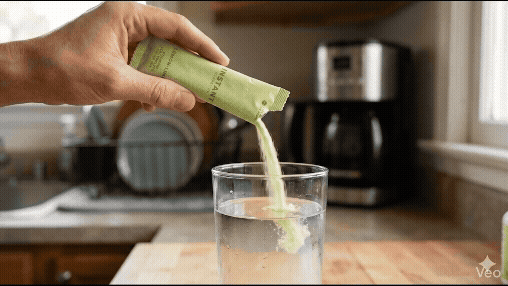
Each packet dissolves completely in eight to sixteen ounces of water. No shaking required. No chalky residue. No aftertaste from artificial sweeteners because there are none. Zero sugar. Zero artificial ingredients. Zero calories. Eighty-four trace minerals from hand-harvested Guérande sel gris. 1,240 milligrams of naturally occurring electrolytes. In a packet that fits in a pocket, a purse, a desk drawer, or a gym bag.
What I recommend to my patients is this: try it for thirty days before you evaluate it. The urine color change typically appears within the first seventy-two hours. That is the first signal the mechanism is responding. The energy changes follow in the second week. The headache and cognitive improvements are slower — allow thirty days before you draw a conclusion. If at day fifty nothing has changed in any of those dimensions, use the guarantee. That is what it is there for.
In twenty-two years of practice I have rarely seen a mechanism this well understood produce results this inconsistent. The biology is not complicated. When you give cells what they need to accept water, they accept water. When they accept water, they function better.
Tomorrow morning you will wake up and do what you do every morning.
You will go to the bathroom. And you will notice the color.
If you start today — if you dissolve one packet into your first glass of water this morning — there is a reasonable probability, based on fourteen thousand people who have done exactly that, that by day three or day four the color you see will be different from the color you have seen every morning for years. Not dramatically. Not overnight. But measurably. Unmistakably. In a direction that confirms something has changed at a level you cannot see but your body has been reporting to you every morning without the translation.
That color change is not cosmetic. You now know what it means. It means the water is reaching your cells. It means the mineral gradient is functioning. It means the aquaporin channels are open and the biological process that eight glasses of plain water never completed is now completing — in the same glass, with the same effort, with one ingredient added that was missing from every glass you have drunk since you were told that eight was enough.
I said at the beginning of this piece that I have spent more than two decades watching people do everything right and still feel wrong.
What I have learned — from twelve patients, from three years of research, and from fourteen thousand people who found their own way to this mechanism — is that doing everything right was never the problem.
The problem was that the right thing was incomplete.
One packet makes it complete.
The statements in this article have not been evaluated by the Food and Drug Administration. This product is not intended to diagnose, treat, cure, or prevent any disease. Individual results may vary. Testimonials represent reported customer experiences and may not reflect typical results. The 50-day money-back guarantee applies to all purchases made through instanthydration.com. Dr. Jonathan Isaacson serves on the Instant Hydration Medical Advisory Board. Comparison table figures reflect publicly available product information at time of writing; competitor formulations may vary by SKU and are subject to change. Verify all figures against current product labels before redistribution.
