The Skin Technology NASA Discovered Is Now Sitting on My Bathroom Counter
It took 30 years to get from a shuttle experiment to a device you can use at home. Dermatologists wish their patients had found it sooner.
In 1993, NASA scientists noticed something strange about the plants they were growing in space. Under specific wavelengths of LED light, the plants were repairing cellular damage faster than they should have been able to. The researchers pivoted. They started testing the same wavelengths on human tissue. What they found became one of the most replicated findings in photobiomodulation research. The Navy eventually funded clinical trials. Dermatologists built it into their treatment protocols. A single in-office session ran $150 to $300. That was the only way to access it — until now.
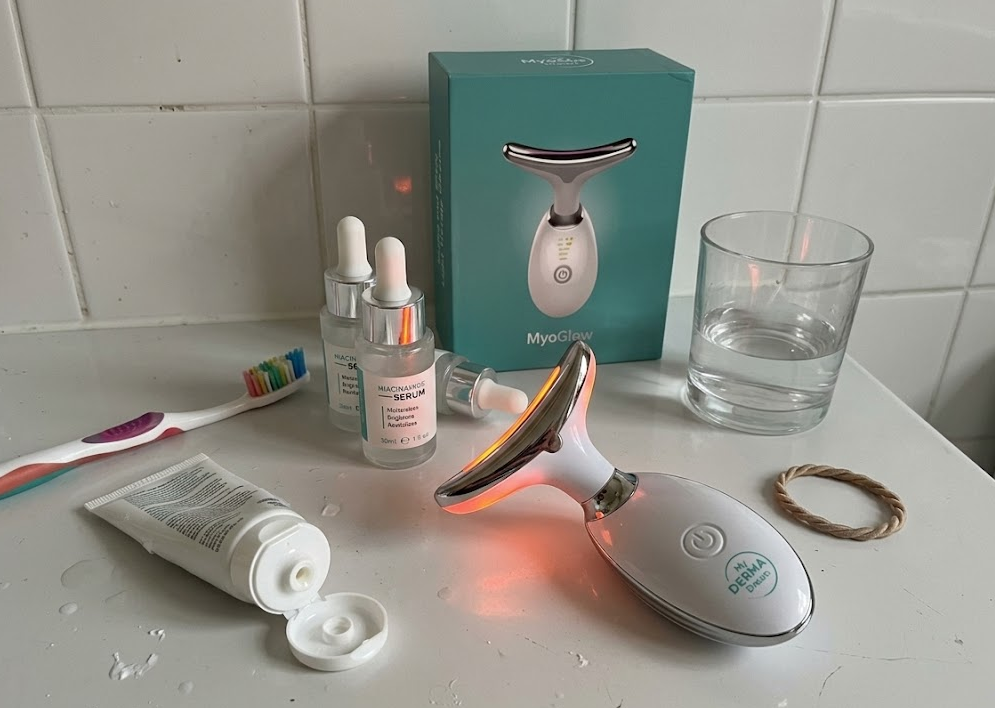
This is not a beauty industry claim. NASA wrote the first papers.
In 1993, NASA scientists noticed something strange about the plants they were growing in space. Under specific wavelengths of LED light, the plants were repairing cellular damage faster than they should have been able to. The researchers pivoted. They started testing the same wavelengths on human tissue.
What they found became one of the most replicated findings in photobiomodulation research: 630 to 660 nanometer red light penetrates the dermis and stimulates mitochondrial activity in skin cells. The mitochondria produce more ATP. The cells use that energy to synthesize collagen and elastin at a rate measurably higher than baseline.
The Navy eventually funded clinical trials using the technology for wound healing in sailors. The results were significant enough that the findings were published across multiple peer-reviewed journals through the late 1990s and early 2000s.
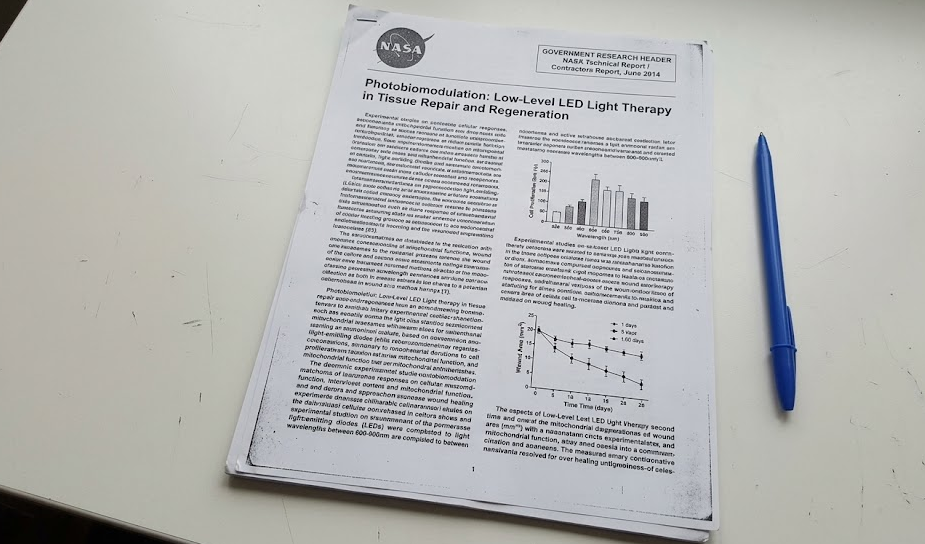
“The original research had nothing to do with beauty. It was purely to do with health.” — Where the research started, 1993.
The problem was always delivery. Getting the right wavelength, at the right intensity, to the right depth of skin tissue, consistently and safely, required equipment that lived in clinics. Dermatologists and cosmetic physicians who understood the research built LED therapy into their treatment protocols. A single in-office session ran $150 to $300. A meaningful course of treatment meant 8 to 12 sessions minimum.
Dr. Whitney Bowe, a board-certified dermatologist whose work has been published in the Journal of Drugs in Dermatology, has described LED light therapy as one of the few non-invasive interventions with legitimate clinical support for collagen stimulation. She is not alone in that assessment.
The research community around photobiomodulation has grown substantially since the NASA findings. A 2014 study in Photomedicine and Laser Surgery showed statistically significant improvement in skin complexion and collagen density after consistent red light exposure at 630nm. A 2022 meta-analysis covering 11 clinical trials confirmed the effect was reproducible across skin types and age groups.
The dermatologists who recommend it aren’t doing it as a favor to the beauty industry. They’re doing it because the mechanism is understood and the data is clean.
The question was always whether a home device could deliver the same wavelength at the therapeutic intensity the clinic equipment used.
For most of the 2000s and 2010s, the honest answer was no. Consumer LED devices were underpowered. They used the right color of light and produced essentially none of the clinical effect.
That changed when manufacturers started building devices around the specific irradiance levels the research actually required — not just the wavelength. The number that matters is the energy dose delivered to the tissue, measured in joules per centimeter squared. The clinical studies that produced real results used doses between 4 and 6 J/cm². Devices that couldn’t hit that threshold weren’t doing what the science described.
MyoGlow was designed around that threshold.
The 630nm wavelength is the same one in the published research. The irradiance is calibrated to the dose range the clinical literature specifies. This is why dermatologists who evaluate home devices treat it differently from the LED masks that flood the market and do approximately nothing.
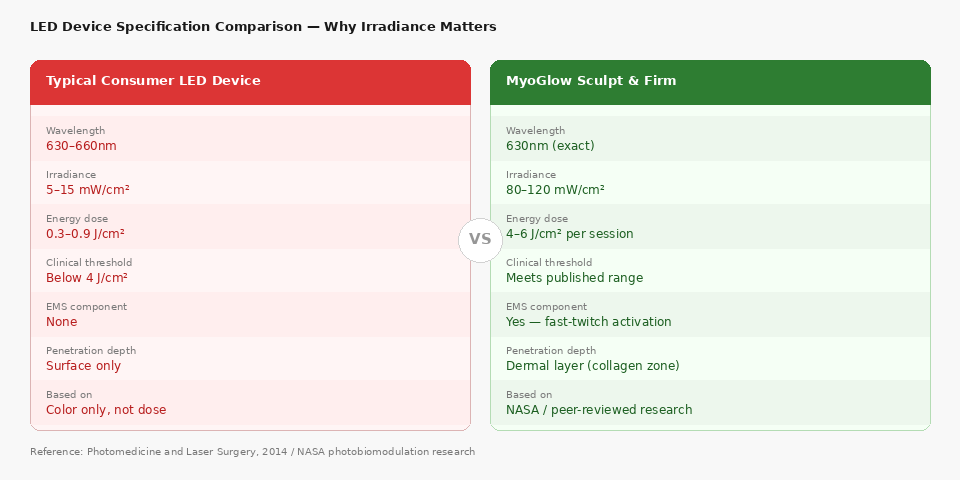
“The difference is not the color. It’s the dose. Reference: Photomedicine and Laser Surgery, 2014 / NASA photobiomodulation research.”
The EMS component works on a separate but complementary track. Electrical muscle stimulation at the frequency MyoGlow uses activates fast-twitch muscle fibers in the treatment area. The red light works on the skin layer. The EMS works on the muscle layer beneath it. Fifteen minutes covers both simultaneously.
Jenna Park, 48, a physician’s assistant in Portland who describes herself as professionally skeptical of consumer wellness devices, tried MyoGlow after her supervising physician mentioned the photobiomodulation research in a continuing education context.
Six weeks in, she described the result plainly:
“The skin on my arms looks the way it did before I had kids. I wouldn’t have believed that sentence before I wrote it.”
She still uses it four times a week.
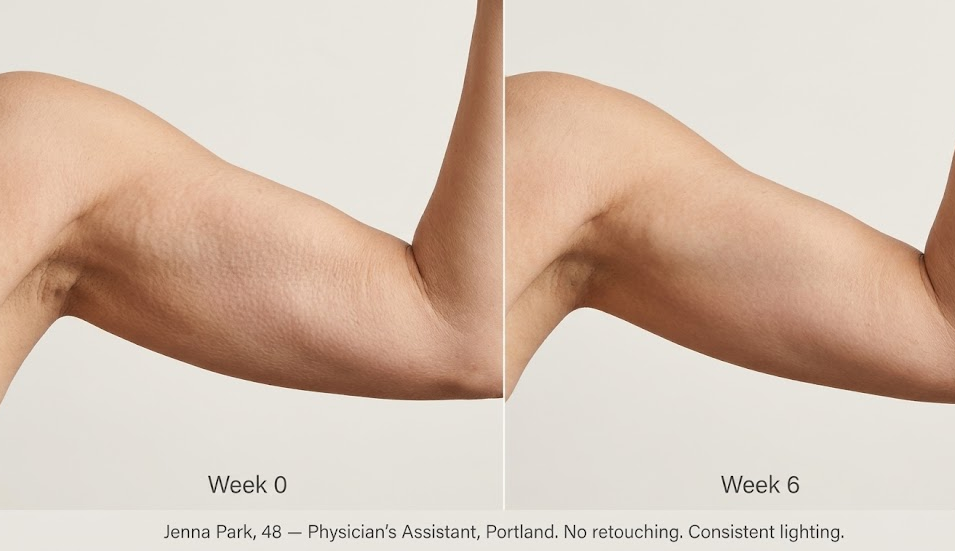
“Jenna Park, 48 — Physician’s Assistant, Portland. Week 0 and Week 6. No retouching. Consistent lighting.”
The technology spent 30 years moving from a NASA greenhouse experiment to a dermatologist’s treatment room to a device that sits on a bathroom counter and takes 15 minutes.
The science did not change in transit. Only the access did.
What the clinic version and the home version share is the mechanism. 630nm at therapeutic irradiance reaches the dermis. The mitochondria respond. Collagen synthesis accelerates. The skin begins to behave more like it did when the cells had more energy to spend on structural maintenance.
That is the entire mechanism. It is not complicated. It is not proprietary. NASA published the foundational research. Dermatologists validated it in clinical practice for three decades. The barrier was never the science. It was access to equipment that could actually deliver the dose.
“I am a physician’s assistant. I read the research before I bought this. The photobiomodulation literature is genuinely solid — this is not a wellness trend, it is a documented mechanism. I was skeptical of whether a home device could deliver the clinical dose. After six weeks I stopped being skeptical. My arms look the way they did before I had children. I would not have written that sentence before I used this for six weeks.”
— Jenna P., 48, Portland, Oregon. Verified purchaser.
“I spent two years doing in-office LED sessions at $250 each. The results were real. I just couldn’t sustain the cost. My dermatologist actually mentioned MyoGlow when I said I needed to stop the clinic appointments. That’s the endorsement I needed. Six weeks in, I’m maintaining what the clinic sessions built. The skin texture is the same. I’m spending significantly less.”
— Rachel K., 52, San Francisco, California. Verified purchaser.
“The NASA origin story sounded like marketing to me the first time I read it. Then I pulled the actual research. It’s real. The 1993 papers exist. The Navy wound-healing trials exist. The 2014 meta-analysis exists. I’m a retired biology teacher. I know how to read a study. The mechanism checks out. The device works at the specified irradiance. I’ve used it for eight weeks. My skin looks measurably different. I wish I’d found this five years ago.”
— Barbara H., 61, Boston, Massachusetts. Verified purchaser.
“Forty-nine years old. I tried one of those cheap LED masks first. Twelve weeks, nothing changed. Then I read about irradiance and realized the dose was completely wrong. MyoGlow is built around the therapeutic threshold. Week four, my husband asked if I’d changed my skincare. I had not. Week seven, my arms looked noticeably firmer. The difference between an underpowered device and a correctly dosed one is not subtle.”
— Christine M., 49, Atlanta, Georgia. Verified purchaser.
“I work in a dermatology clinic. LED therapy is part of our treatment menu. I know exactly what it does and how it works. When I started seeing home devices built around the actual irradiance specifications rather than just the wavelength, I paid attention. MyoGlow is one of the first consumer devices where the specs match what the clinical literature requires. I use it at home on the days I’m not in the clinic. The results are consistent with what I see from our in-office equipment.”
— Lauren S., 44, New York, New York. Verified purchaser.
“The EMS component was the surprise for me. I bought it for the red light. The muscle activation from the EMS in the first session was stronger than I expected from something I could hold in one hand. By week three, the combination was visible — the skin was tighter and the underlying definition was more pronounced. Fifteen minutes. Four times a week. I do it while I watch TV. The bar for doing this is so low that I don’t understand why I waited so long.”
— Susan R., 55, Dallas, Texas. Verified purchaser.
The science did not change in transit from NASA to your bathroom counter. Only the access did.
The in-office LED session that runs $250 and the MyoGlow session that runs fifteen minutes in your living room are delivering the same mechanism to the same layer of tissue. The dermatologists who built their practices around photobiomodulation didn’t do it because it was fashionable. They did it because the NASA research was clean, the Navy trials were rigorous, and the mechanism was reproducible across every skin type and age group that showed up in the literature.
What changed is that you no longer need a clinic appointment to access the therapeutic dose. You need fifteen minutes and a bathroom counter.
Money-Back Guarantee — If the skin texture doesn’t change. If the definition doesn’t follow. If after consistent use you cannot see a difference — return it. Full refund. No explanation required. The guarantee exists because the mechanism is real. If it doesn’t work for you, you pay nothing.
MyoGlow is currently available at a discount for first-time customers.
630nm at therapeutic irradiance. EMS fast-twitch activation. Fifteen minutes per session. Four to five sessions per week. In a device that sits on a bathroom counter and requires no appointment, no clinic, and no recovery time.
Try it for six weeks before you evaluate it. Skin texture typically changes around week three — that is the first signal the collagen response is happening. Definition follows in weeks five and six. By week eight you will know whether this is working. If it isn’t, the guarantee covers you.
NASA noticed the mechanism in 1993. The Navy confirmed it. Dermatologists used it for 30 years at $250 a session.
The research did not change. The access did.
Fifteen minutes. Same science. Your bathroom counter.
